Unit 5 the Mole Review for Full Credit Be Sure to Show Your Work!
Learning Objectives
By the end of this section, you lot will exist able to:
- Define the amount unit of measurement mole and the related quantity Avogadro'south number
- Explain the relation betwixt mass, moles, and numbers of atoms or molecules, and perform calculations deriving these quantities from one another
The Mole
The identity of a substance is defined not simply by the types of atoms or ions it contains, only by the quantity of each type of atom or ion. For instance, h2o, H2O, and hydrogen peroxide, H2O2, are alike in that their respective molecules are equanimous of hydrogen and oxygen atoms. However, considering a hydrogen peroxide molecule contains two oxygen atoms, as opposed to the water molecule, which has only 1, the two substances exhibit very dissimilar properties. Today, we possess sophisticated instruments that allow the direct measurement of these defining microscopic traits; however, the same traits were originally derived from the measurement of macroscopic properties (the masses and volumes of majority quantities of matter) using relatively simple tools (balances and volumetric glassware). This experimental approach required the introduction of a new unit for amount of substances, the mole, which remains indispensable in modern chemic science.
The mole is an amount unit similar to familiar units like pair, dozen, gross, etc. It provides a specific measure of the number of atoms or molecules in a bulk sample of thing. A mole is divers as the amount of substance containing the aforementioned number of discrete entities (atoms, molecules, ions, etc.) equally the number of atoms in a sample of pure 12C weighing exactly 12 g. 1 Latin connotation for the word "mole" is "large mass" or "bulk," which is consequent with its use as the name for this unit. The mole provides a link between an hands measured macroscopic property, majority mass, and an extremely important key holding, number of atoms, molecules, and and so forth.
The number of entities composing a mole has been experimentally determined to exist [latex]half-dozen.02214179\times {10}^{23}[/latex], a fundamental constant named Avogadro's number (NorthwardA ) or the Avogadro constant in honour of Italian scientist Amedeo Avogadro. This constant is properly reported with an explicit unit of "per mole," a conveniently rounded version existence [latex]half dozen.022\times {10}^{23}\text{/mol}[/latex].
Consistent with its definition as an amount unit, one mole of any chemical element contains the aforementioned number of atoms as ane mole of whatsoever other chemical element. The masses of ane mole of different elements, however, are unlike, since the masses of the private atoms are drastically unlike. The molar mass of an element (or compound) is the mass in grams of 1 mole of that substance, a belongings expressed in units of grams per mole (g/mol) (come across Figure ane).
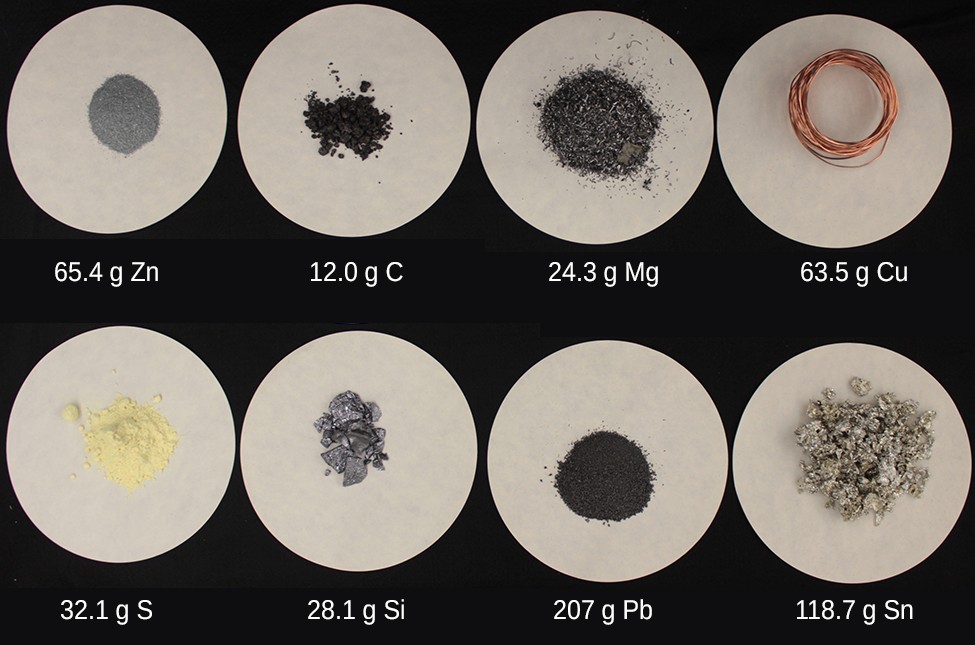
Effigy 1. Each sample contains half dozen.022 × ten23 atoms—1.00 mol of atoms. From left to right (top row): 65.4g zinc, 12.0g carbon, 24.3g magnesium, and 63.5g copper. From left to right (bottom row): 32.1g sulfur, 28.1g silicon, 207g lead, and 118.7g can. (credit: modification of work past Mark Ott)
Considering the definitions of both the mole and the atomic mass unit are based on the same reference substance, 12C, the molar mass of whatsoever substance is numerically equivalent to its diminutive or formula weight in amu. Per the amu definition, a single 12C cantlet weighs 12 amu (its atomic mass is 12 amu). According to the definition of the mole, 12 yard of 12C contains 1 mole of 12C atoms (its tooth mass is 12 g/mol). This human relationship holds for all elements, since their diminutive masses are measured relative to that of the amu-reference substance, 12C. Extending this principle, the molar mass of a compound in grams is likewise numerically equivalent to its formula mass in amu (Figure 2).
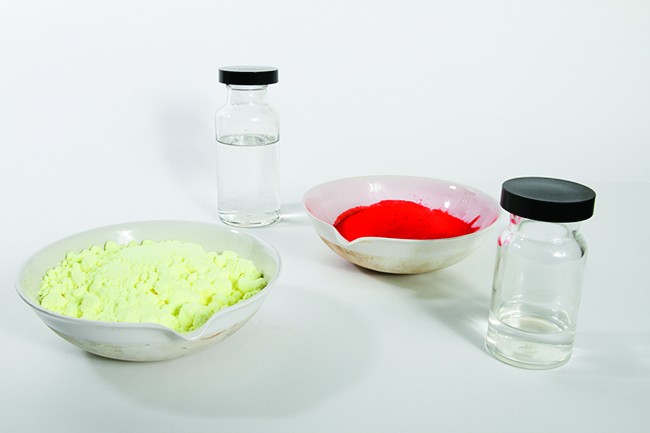
Effigy ii. Each sample contains six.02 × 1023 molecules or formula units—1.00 mol of the compound or element. Clock-wise from the upper left: 130.2g of C8H17OH (one-octanol, formula mass 130.ii amu), 454.9g of HgI2 (mercury(II) iodide, formula mass 459.9 amu), 32.0g of CH3OH (methanol, formula mass 32.0 amu) and 256.5g of Seight (sulfur, formula mass 256.6 amu). (credit: Sahar Atwa)
| Element | Average Atomic Mass (amu) | Tooth Mass (g/mol) | Atoms/Mole |
|---|---|---|---|
| C | 12.01 | 12.01 | [latex]6.022\times {10}^{23}[/latex] |
| H | 1.008 | 1.008 | [latex]vi.022\times {10}^{23}[/latex] |
| O | 16.00 | xvi.00 | [latex]six.022\times {10}^{23}[/latex] |
| Na | 22.99 | 22.99 | [latex]half dozen.022\times {10}^{23}[/latex] |
| Cl | 33.45 | 33.45 | [latex]6.022\times {x}^{23}[/latex] |
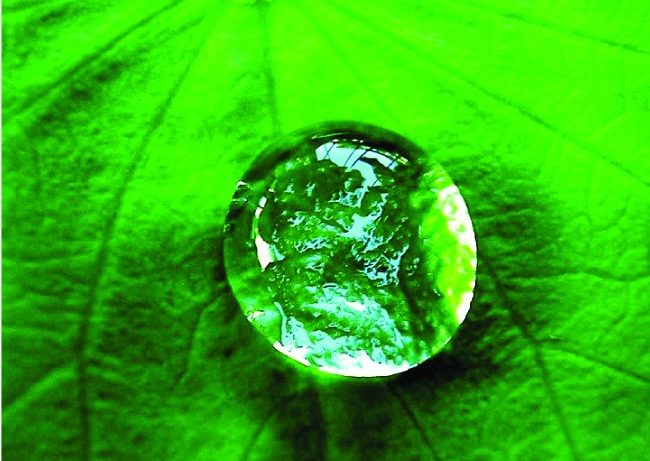
Figure 3. A unmarried drop of water.
While atomic mass and tooth mass are numerically equivalent, go on in heed that they are vastly dissimilar in terms of scale, as represented past the vast difference in the magnitudes of their corresponding units (amu versus thousand). To capeesh the enormity of the mole, consider a pocket-size drop of h2o weighing near 0.03 g (see Figure 3). The number of molecules in a single droplet of water is roughly 100 billion times greater than the number of people on earth.
Although this represents just a tiny fraction of i mole of h2o (~xviii chiliad), it contains more than h2o molecules than can be conspicuously imagined. If the molecules were distributed equally amongst the roughly seven billion people on globe, each person would receive more than than 100 billion molecules.
The mole is used in chemical science to represent [latex]half dozen.022\times {10}^{23}[/latex] of something, but it can be difficult to conceptualize such a large number. Watch this video to learn more.
The relationships between formula mass, the mole, and Avogadro's number can exist practical to compute diverse quantities that describe the composition of substances and compounds. For instance, if we know the mass and chemical composition of a substance, we can make up one's mind the number of moles and summate number of atoms or molecules in the sample. Besides, if nosotros know the number of moles of a substance, we can derive the number of atoms or molecules and calculate the substance'south mass.
Example 1: Deriving Moles from Grams for an Chemical element
According to nutritional guidelines from the The states Department of Agronomics, the estimated boilerplate requirement for dietary potassium is iv.seven thou. What is the estimated average requirement of potassium in moles?
Cheque Your Learning
Beryllium is a light metallic used to fabricate transparent X-ray windows for medical imaging instruments. How many moles of Be are in a thin-foil window weighing 3.24 g?
Example 2: Deriving Grams from Moles for an Element
A liter of air contains [latex]ix.2\times {10}^{-4}[/latex] mol argon. What is the mass of Ar in a liter of air?
Check Your Learning
What is the mass of two.561 mol of gold?
Example 3: Deriving Number of Atoms from Mass for an Element
Copper is usually used to fabricate electric wire (Effigy 7). How many copper atoms are in 5.00 g of copper wire?
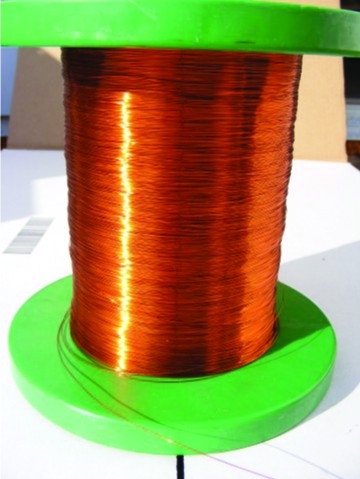
Figure 7. Copper wire is composed of many, many atoms of Cu. (credit: Emilian Robert Vicol)
Check Your Learning
A prospector panning for gold in a river collects 15.00 g of pure gold. How many Au atoms are in this quantity of golden?
Show Answer
[latex]iv.586\times {x}^{22}\text{Au atoms}[/latex]
Example 4: Deriving Moles from Grams for a Compound
Our bodies synthesize protein from amino acids. 1 of these amino acids is glycine, which has the molecular formula CtwoH5O2N. How many moles of glycine molecules are contained in 28.35 m of glycine?
Cheque Your Learning
How many moles of sucrose, C12H22O11, are in a 25-g sample of sucrose?
Example 5: Deriving Grams from Moles for a Compound
Vitamin C is a covalent compound with the molecular formula C6H8O6. The recommended daily dietary assart of vitamin C for children anile four–8 years is [latex]1.42\times {ten}^{-4}\text{mol.}[/latex] What is the mass of this allowance in grams?
Check Your Learning
What is the mass of 0.443 mol of hydrazine, N2H4?
Instance 6: Deriving the Number of Atoms and Molecules from the Mass of a Chemical compound
A packet of an artificial sweetener contains 40.0 mg of saccharin (CsevenHvNOthreeS), which has the structural formula:
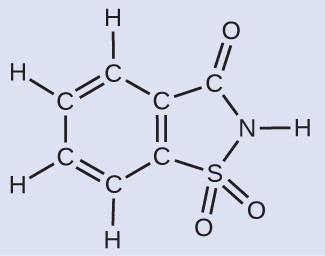
Given that saccharin has a molar mass of 183.18 g/mol, how many saccharin molecules are in a 40.0-mg (0.0400-g) sample of saccharin? How many carbon atoms are in the aforementioned sample?
Check Your Learning
How many CivH10 molecules are independent in 9.213 g of this chemical compound? How many hydrogen atoms?
Show Answer
[latex]nine.545\times {10}^{22}\text{molecules }{\text{C}}_{four}{\text{H}}_{10}\text{; }ix.545\times {10}^{23}\text{ atoms H}[/latex]
Central Concepts and Summary
A convenient amount unit for expressing very large numbers of atoms or molecules is the mole. Experimental measurements have determined the number of entities composing 1 mole of substance to be [latex]six.022\times {10}^{23}[/latex], a quantity called Avogadro's number. The mass in grams of i mole of substance is its molar mass. Due to the use of the same reference substance in defining the atomic mass unit and the mole, the formula mass (amu) and molar mass (m/mol) for any substance are numerically equivalent (for instance, one H2O molecule weighs approximately18 amu and one mole of H2O molecules weighs approximately 18 g).
Exercises
- Write a sentence that describes how to determine the number of moles of a compound in a known mass of the chemical compound if we know its molecular formula.
- Compare 1 mole of Hii, 1 mole of O2, and one mole of Fii.
- Which has the largest number of molecules? Explain why.
- Which has the greatest mass? Explain why.
- Which contains the greatest mass of oxygen: 0.75 mol of ethanol (C2H5OH), 0.sixty mol of formic acid (HCOiiH), or ane.0 mol of water (HiiO)? Explain why.
- Which contains the greatest number of moles of oxygen atoms: 1 mol of ethanol (CiiH5OH), 1 mol of formic acid (HCOtwoH), or 1 mol of water (H2O)? Explain why.
- How are the molecular mass and the tooth mass of a compound similar and how are they different?
- Calculate the molar mass of each of the following compounds:
- hydrogen fluoride, HF
- ammonia, NH3
- nitric acid, HNO3
- silver sulfate, Ag2So4
- boric acid, B(OH)3
- Calculate the molar mass of each of the post-obit:
- S8
- CfiveH12
- Sc2(SO4)three
- CH3COCHthree (acetone)
- CsixH12O6 (glucose)
- Calculate the molar mass of each of the following minerals:
- limestone, CaCO3
- halite, NaCl
- beryl, Be3Al2Sihalf-dozenO18
- malachite, Cu2(OH)2CO3
- turquoise, CuAlsix(PO4)4(OH)8(H2O)iv
- Calculate the molar mass of each of the following:
- the anesthetic halothane, C2HBrClFthree
- the herbicide paraquat, C12H14N2Cl2
- caffeine, C8H10Due north4O2
- urea, CO(NHtwo)2
- a typical lather, C17H35CO2Na
- Determine the number of moles of compound and the number of moles of each type of atom in each of the post-obit:
- 25.0 g of propylene, C3H6
- [latex]3.06\times {ten}^{-3}\text{g}[/latex] of the amino acrid glycine, C2H5NOii
- 25 lb of the herbicide Treflan, CxiiiH16N2O4F (1 lb = 454 g)
- 0.125 kg of the insecticide Paris Dark-green, Cu4(AsOthree)2(CH3CO2)2
- 325 mg of aspirin, C6H4(CO2H)(CO2CH3)
- Determine the mass of each of the following:
- 0.0146 mol KOH
- 10.ii mol ethane, C2Hhalf-dozen
- [latex]i.six\times {10}^{-3}\text{ mol }{\text{Na}}_{2}{\text{And then}}_{four}[/latex]
- [latex]6.854\times {10}^{iii}\text{ mol glucose},{\text{C}}_{six}{\text{H}}_{12}{\text{O}}_{6}[/latex]
- 2.86 mol Co(NH3)half-dozenClthree
- Determine the number of moles of the compound and make up one's mind the number of moles of each blazon of atom in each of the post-obit:
- 2.12 chiliad of potassium bromide, KBr
- 0.1488 thou of phosphoric acrid, HiiiPO4
- 23 kg of calcium carbonate, CaCO3
- 78.452 g of aluminum sulfate, Al2(And then4)3
- 0.1250 mg of caffeine, CeightH10N4Oii
- Make up one's mind the mass of each of the post-obit:
- 2.345 mol LiCl
- 0.0872 mol acetylene, CiiH2
- [latex]3.3\times {10}^{-2}\text{ mol }{\text{Na}}_{2}{\text{CO}}_{3}[/latex]
- [latex]1.23\times {10}^{three}\text{ mol fructose, }{\text{C}}_{six}{\text{H}}_{12}{\text{O}}_{6}[/latex]
- 0.5758 mol FeSOiv(HtwoO)7
- The approximate minimum daily dietary requirement of the amino acid leucine, Chalf-dozenH13NO2, is i.ane thou. What is this requirement in moles?
- Determine the mass in grams of each of the following:
- 0.600 mol of oxygen atoms
- 0.600 mol of oxygen molecules, O2
- 0.600 mol of ozone molecules, O3
- A 55-kg woman has [latex]7.five\times {ten}^{-3}\text{mol}[/latex] of hemoglobin (molar mass = 64,456 m/mol) in her blood. How many hemoglobin molecules is this? What is this quantity in grams?
- Determine the number of atoms and the mass of zirconium, silicon, and oxygen constitute in 0.3384 mol of zircon, ZrSiOfour, a semiprecious rock.
- Determine which of the following contains the greatest mass of hydrogen: i mol of CH4, 0.6 mol of Chalf dozenHhalf-dozen, or 0.4 mol of C3H8.
- Determine which of the following contains the greatest mass of aluminum: 122 yard of AlPO4, 266 one thousand of AliiCl6, or 225 m of AltwoS3.
- Diamond is ane class of elemental carbon. An engagement ring contains a diamond weighing 1.25 carats (1 carat = 200 mg). How many atoms are nowadays in the diamond?
- The Cullinan diamond was the largest natural diamond ever institute (January 25, 1905). Information technology weighed 3104 carats (1 carat = 200 mg). How many carbon atoms were nowadays in the stone
- One 55-gram serving of a detail cereal supplies 270 mg of sodium, 11% of the recommended daily assart. How many moles and atoms of sodium are in the recommended daily allowance?
- A certain nut crunch cereal contains 11.0 grams of sugar (sucrose, C12H22O11) per serving size of lx.0 grams. How many servings of this cereal must be eaten to consume 0.0278 moles of sugar?
- A tube of toothpaste contains 0.76 g of sodium monofluorophosphate (NatwoPOiiiF) in 100 mL
- What mass of fluorine atoms in mg was nowadays?
- How many fluorine atoms were present?
- Which of the following represents the least number of molecules?
- 20.0 yard of H2O (18.02 yard/mol)
- 77.0 g of CH4 (xvi.06 g/mol)
- 68.0 one thousand of CaH2 (42.09 yard/mol)
- 100.0 g of N2O (44.02 g/mol)
- 84.0 thousand of HF (20.01 g/mol)
Glossary
Avogadro'due south number (NA ): experimentally determined value of the number of entities comprising i mole of substance, equal to [latex]6.022\times {10}^{23}{\text{mol}}^{-1}[/latex]
molar mass: mass in grams of ane mole of a substance
mole: amount of substance containing the same number of atoms, molecules, ions, or other entities every bit the number of atoms in exactly 12 grams of 12C
stapletonholl1956.blogspot.com
Source: https://courses.lumenlearning.com/suny-mcc-introductorychemistry/chapter/formula-mass-and-mole-concept-from-che151/
0 Response to "Unit 5 the Mole Review for Full Credit Be Sure to Show Your Work!"
Post a Comment